



























































































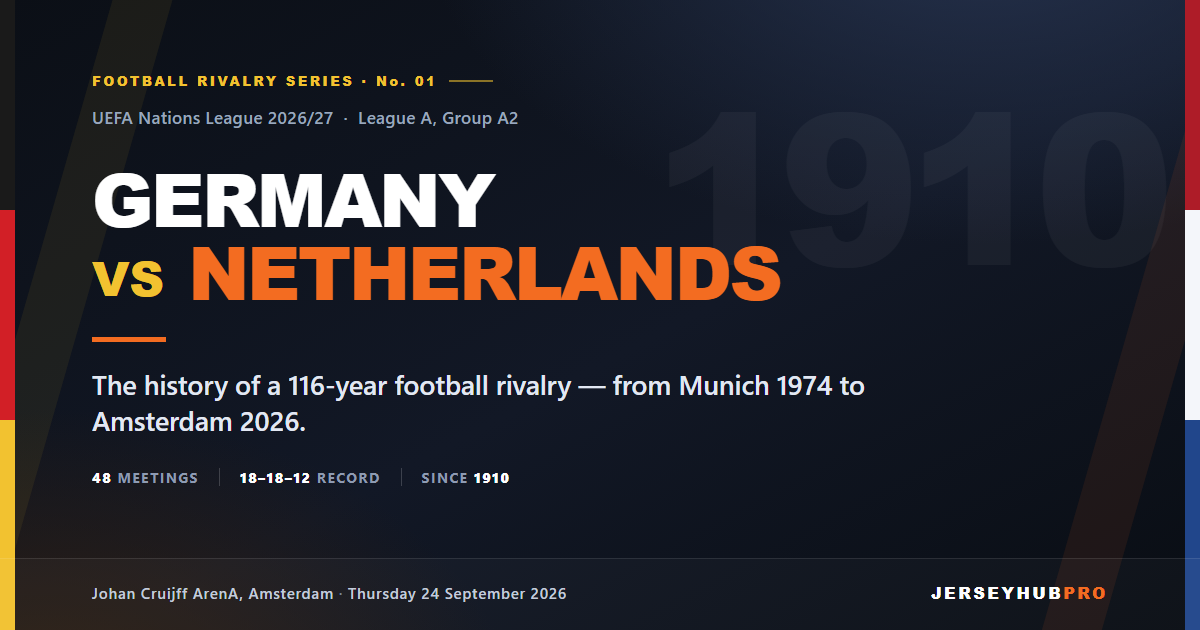
Nations League 2026/27 · League A, Group A2
Germany vs NetherlandsOne rivalry, two debutants, and a fixture that has been running since 1910
No other European fixture carries quite this much history, this much argument about how football should be played — or this many nights that both countries still talk about.
On the evening of 24 September 2026, the Netherlands and Germany will walk out at the Johan Cruijff ArenA to open their Nations League campaign against each other. It will be the 49th meeting between the two countries. It will also be the first competitive match in charge for both managers, which is a strange thing to be able to say about a fixture that has been running for 116 years.
That is the shape of the rivalry in 2026. The history is enormous, the present is completely unsettled, and the two things have to share the same 90 minutes. Germany arrive with Jürgen Klopp in charge for the first time. The Netherlands arrive with Xavi Hernández in charge for the first time. Neither can lean on an established pattern, because neither has one yet.
What they can lean on is everything that happened before.
Two countries, two ideas of what football is for
Most international rivalries are built on geography or on a specific grievance. This one is built on philosophy. Germany and the Netherlands have spent the better part of a century disagreeing about what the game is supposed to look like, and the results have rarely been as one-sided as the reputations suggest.
Germany’s tradition is the tournament tradition: four World Cups, three European Championships, and a long record of arriving at the business end of competitions and finding a way through. The Dutch tradition is the aesthetic one — Total Football, Johan Cruyff, Rinus Michels, and an idea about space and possession that ended up shaping clubs and national teams far beyond the Netherlands.
The cost of that idealism is written into the record too. The Netherlands have lost three World Cup finals — 1974, 1978 and 2010 — more than any other nation that has never won the trophy, and their only major title remains the European Championship of 1988. For a country that has produced so much of the game’s thinking, it is a startlingly thin cabinet. That tension, between playing well and winning, sits underneath almost every chapter of this rivalry.
Munich, 1974: the wound the rivalry is built on
The 1974 World Cup final at the Olympiastadion in Munich is the match that made this fixture what it is. The Netherlands had spent the tournament establishing Total Football as something genuinely new, and they reached the final having beaten Argentina, East Germany and Brazil. West Germany, the hosts, had rebuilt quietly around Franz Beckenbauer.
Within two minutes the Netherlands were ahead, Johan Neeskens converting a penalty. West Germany equalised from the spot through Paul Breitner on 25 minutes, and two minutes before half-time Gerd Müller turned in the goal that decided the trophy. West Germany won 2–1 in front of 75,200 people, with Jack Taylor of England refereeing.
The Netherlands have spent half a century being told that they were the best team at that tournament. The Dutch have a phrase for it that has outlived most of the players: the mother of all defeats.
Argentina, 1978: the rematch nobody had to wait for
Four years later they were drawn together again, in the second group stage of the 1978 World Cup. The Netherlands took the lead through Arie Haan and then, after West Germany had turned the match around through Rudi Abramczik and Dieter Müller, Robert “Rob” van de Kerkhof equalised on 84 minutes to make it 2–2.
The draw was enough for the Netherlands to reach a second consecutive World Cup final, where they lost to the hosts, Argentina. West Germany went out. It is one of the great quirks of this rivalry that the two most famous Dutch performances against Germany at the World Cup — a defeat and a draw — are both remembered as moral victories.
1980 and the long decade in between
The next competitive meeting came at the 1980 European Championship in Italy, and it produced one of the strangest scorelines in the whole series. Klaus Allofs scored a hat-trick — on 20, 60 and 65 minutes — to put West Germany 3–0 up in Naples. Johnny Rep pulled one back from the penalty spot on 79 minutes and Willy van de Kerkhof made it 3–2 six minutes later. West Germany held on.
Before that there had been a long stretch of friendlies, including a West German win in Düsseldorf in 1978 and a draw in Eindhoven in 1980. That pattern — long gaps filled with friendlies, periodically interrupted by something enormous — is how this rivalry has actually worked for most of its existence.
Hamburg, 1988: the night the Netherlands finally won
If 1974 is the wound, Hamburg is the scar tissue. The semi-final of Euro 1988 at the Volksparkstadion was the Netherlands’ best chance to avenge Munich, and the match went the way the best versions of Dutch football go: a penalty from Ronald Koeman on 74 minutes after Lothar Matthäus had put West Germany ahead from the spot on 55, and then, with two minutes left, Marco van Basten scoring the winner.
The Netherlands beat the Soviet Union in the final and won their only major international trophy. Ronald Koeman, who scored that penalty in Hamburg, went on to manage the Netherlands across two separate spells, the second of which ended after the 2026 World Cup. Marco van Basten, who scored the winner, went on to manage the national team himself. The 1988 semi-final is the single most important result in Dutch football history, and it happened against Germany.
Milan, 1990: the night it stopped being polite
Two years later they met in the round of 16 at the 1990 World Cup at the San Siro, and the match is remembered for something other than the football. Jürgen Klinsmann and Andreas Brehme put West Germany two goals up. Ronald Koeman scored a late penalty for the Netherlands. And in between, Frank Rijkaard spat into Rudi Völler’s hair — twice, the second time as the pair were leaving the pitch after both had been sent off.
West Germany won 2–1 and went on to win the tournament. The image of Rijkaard and Völler has outlasted the match itself, and for a lot of supporters under the age of 45 it is the first thing they associate with this fixture.
Gothenburg, Porto, Kharkiv: the modern record
At Euro 1992 in Sweden, the Netherlands won the group meeting 3–1, with goals from Rijkaard, Rob Witschge and Dennis Bergkamp, Klinsmann replying. Then the fixture went quiet for a decade.
It returned at Euro 2004 in Portugal with a 1–1 draw in Porto — Torsten Frings for Germany, Ruud van Nistelrooy equalising on 81 minutes. At Euro 2012 in Kharkiv, Germany won 2–1 with two first-half goals from Mario Gómez and a late reply from Robin van Persie.
Around that, there were qualifiers and friendlies that never quite became part of the folklore: a 3–0 German win in Hamburg in November 2011, a 3–2 German win in Amsterdam in March 2019, and then a 4–2 Dutch victory in Hamburg in September 2019 that remains one of the Netherlands’ best results in the fixture this century.
The Nations League gives the rivalry a stage it didn’t have
The Nations League has done something odd to this fixture. Because the competition groups teams by ranking, Germany and the Netherlands have been drawn together repeatedly, and a rivalry that used to surface once a decade now appears on a biennial schedule.
In the 2018/19 edition they were in the same League A group. The Netherlands won 3–0 in Amsterdam in October 2018, with goals from Virgil van Dijk, Memphis Depay and Georginio Wijnaldum. The return in Gelsenkirchen a month later is the reason Dutch supporters trust this competition: Germany led 2–0 inside twenty minutes through Timo Werner and Leroy Sané, and the Netherlands scored twice in the last five minutes — Quincy Promes on 85, Van Dijk on 90+1 — to rescue the point that took them to the Nations League Finals ahead of France, in the same match that confirmed Germany’s relegation.
In 2024/25 they were drawn together again. The first meeting in Amsterdam finished 2–2, with Tijjani Reijnders scoring after two minutes, Deniz Undav and Joshua Kimmich putting Germany ahead either side of half-time, and Denzel Dumfries equalising on 50. The return in Munich in October 2024 was settled by Jamie Leweling on 64 minutes, and finished 1–0 to Germany.
Germany are unbeaten in the last four meetings between the two countries. None of those four results, though, has been decided by more than one goal.
Amsterdam, 2026: two managers, no track record
Which brings us to the present, and to the reason this particular renewal of the rivalry is hard to read.
Germany will be managed by Jürgen Klopp for the first time. Julian Nagelsmann stepped down on 3 July 2026, days after Germany were eliminated from the World Cup in the round of 32 by Paraguay on penalties, and Klopp was appointed in late July, formally taking over on 15 August on a contract running to 2030. Amsterdam is his first match in the job. It also sent Nagelsmann out on a piece of unwanted history: Germany had never previously lost a World Cup penalty shootout.
The Netherlands will be managed by Xavi Hernández for the first time. The KNVB appointed him on 12 August 2026 on a deal running through the 2030 World Cup, replacing Ronald Koeman, who left after the Dutch were eliminated in the round of 32 by Morocco, also on penalties, after a 1–1 draw in which Cody Gakpo had given them the lead. Xavi is the Netherlands’ first foreign head coach since the Austrian Ernst Happel took them to the 1978 World Cup final — the same tournament in which they drew with West Germany.
At his presentation at the KNVB headquarters in Zeist, Xavi framed the job in terms his new public would recognise, describing himself as “a bit of a son of Dutch football” because of his Barcelona upbringing under the influence of Cruyff and Michels.
Klopp’s own framing, on being appointed by the DFB, was about something narrower. “Few things can bring us Germans together like the national team,” he said. Both statements are, in their own way, about the same thing: two proud football countries trying to remember what they are.
The two fixtures that decide the group
Germany and the Netherlands are in League A Group A2 alongside Serbia and Greece. They play each other twice: in Amsterdam on 24 September 2026, and then at the Olympiastadion in Berlin on Monday 16 November 2026, in the final round of group matches.
Berlin is a fitting place to finish. The Olympiastadion is where Germany have played some of the biggest matches in their history, and it will be the venue for the second instalment of a rivalry that began in 1910, resumed after two world wars, survived its most poisonous night in Milan, and has now been handed to two managers who have never taken charge of a competitive international match before.
Germany vs Netherlands at a glance
| Meetings | 48 |
| Germany wins | 18 |
| Draws | 18 |
| Netherlands wins | 12 |
| Goals | Germany 90 – Netherlands 79 |
| First meeting | 24 April 1910 |
| Last meeting | 14 October 2024 · Munich · Germany 1–0 Netherlands |
| Next meeting | 24 September 2026 · Amsterdam |
Every competitive meeting
| Year | Competition | Stage | Result |
|---|---|---|---|
| 1974 | World Cup | Final | Netherlands 1–2 West Germany |
| 1978 | World Cup | Second group stage | West Germany 2–2 Netherlands |
| 1980 | European Championship | Group stage | West Germany 3–2 Netherlands |
| 1988 | European Championship | Semi-final | West Germany 1–2 Netherlands |
| 1990 | World Cup | Round of 16 | West Germany 2–1 Netherlands |
| 1992 | European Championship | Group stage | Netherlands 3–1 Germany |
| 2004 | European Championship | Group stage | Netherlands 1–1 Germany |
| 2012 | European Championship | Group stage | Netherlands 1–2 Germany |
| 2018 | Nations League | League A group | Netherlands 3–0 Germany |
| 2018 | Nations League | League A group | Germany 2–2 Netherlands |
| 2024 | Nations League | League A group | Netherlands 2–2 Germany |
| 2024 | Nations League | League A group | Germany 1–0 Netherlands |
Wear the rivalry
Both nations have new home and away kits in circulation for the 2026/27 cycle, plus national-team ranges that reach back into the archive. Netherlands home shirts are the orange; Germany are the white-with-black-trim that has been the DFB’s default for most of the modern era.
Shop by team
Shop by range
Germany
 MEN Men's 2026/27 Germany Home Shirt (Schlotterbeck 15) $64.99 Shop Now
  MEN Men's Germany 125th Anniversary Shirt (Gnabry 10) $64.99 Shop Now
 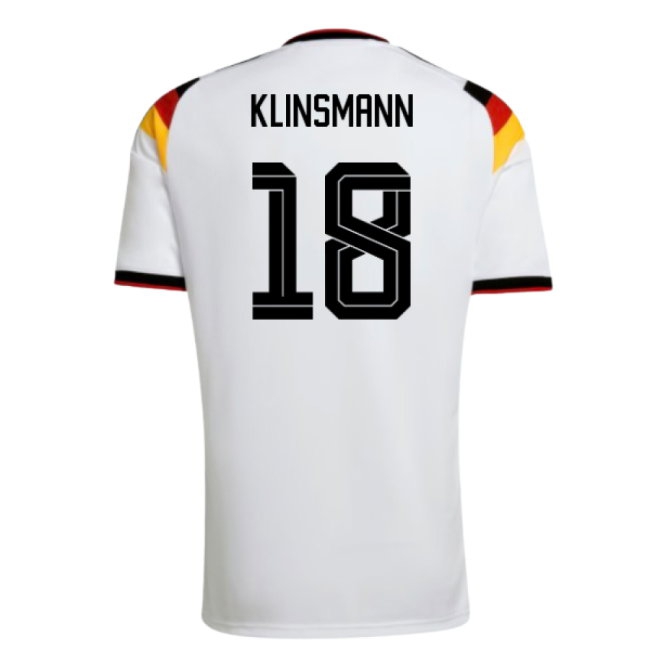 KIDS Kids' 2026/27 Germany Home Shirt (Klinsmann 18) $53.99 Shop Now
 Netherlands
 MEN Men's 2026/27 Netherlands Home Shirt (Dumfries 22) $64.99 Shop Now
 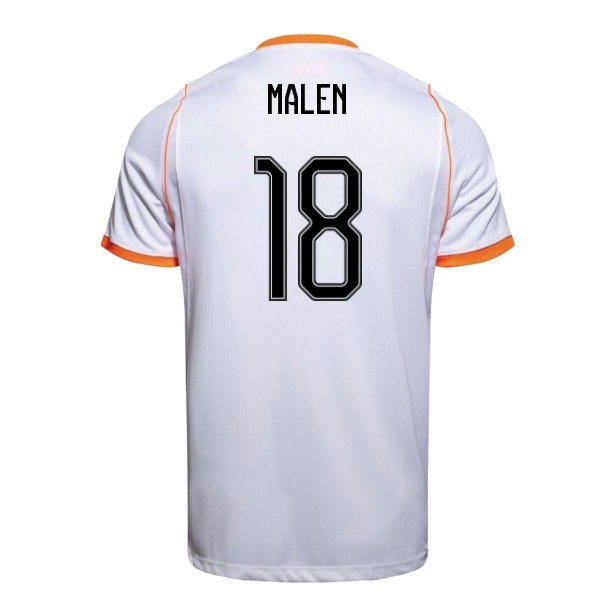 MEN Men's 2026/27 Netherlands Away Shirt (Malen 18) $64.99 Shop Now
  WOMEN Women's 2026/27 Netherlands Home Shirt (Gakpo 11) $58.99 Shop Now
 Where to go next
National team jerseys
- All national team jerseys — every federation range on the site
- Germany jerseys · Germany men’s · Germany retro
- Netherlands jerseys · Netherlands men’s · Netherlands retro
More from this series
- All football rivalry features
- Coming next: England vs Spain · Italy vs France · Croatia vs England
- World Cup jerseys · FIFA range
Frequently asked questions
How many times have Germany and the Netherlands played each other?
48 times through October 2024: 18 German wins, 18 draws and 12 Dutch wins, with Germany scoring 90 goals to the Netherlands’ 79. The countries first met on 24 April 1910. The Amsterdam fixture on 24 September 2026 will be the 49th meeting.
Who has the better record in the rivalry, Germany or the Netherlands?
Germany lead the all-time series 18 wins to 12, with 18 draws. The Netherlands’ record in the biggest matches is better than the overall numbers suggest: they won the Euro 1988 semi-final in Hamburg and the Euro 1992 group meeting, but lost the 1974 World Cup final and the 1990 World Cup round-of-16 tie.
When do Germany and the Netherlands next play each other?
They meet at the Johan Cruijff ArenA in Amsterdam on Thursday 24 September 2026 at 20:45 CEST, in the opening round of the 2026/27 UEFA Nations League league phase. The return fixture is at the Olympiastadion in Berlin on Monday 16 November 2026.
What is the most famous match between Germany and the Netherlands?
The 1974 World Cup final in Munich, which West Germany won 2–1 with goals from Paul Breitner and Gerd Müller after Johan Neeskens had given the Netherlands a second-minute lead. The Euro 1988 semi-final in Hamburg, where the Netherlands won 2–1 on the way to their only major title, is the Dutch answer to the same question.
About this series. This is a football history feature, not a preview or a prediction. Every scoreline and date above is taken from the competitive record of the fixture; quotes are attributed to the public statements they came from.
Looking for shirts from this fixture? Shop national team jerseys · Germany · Netherlands